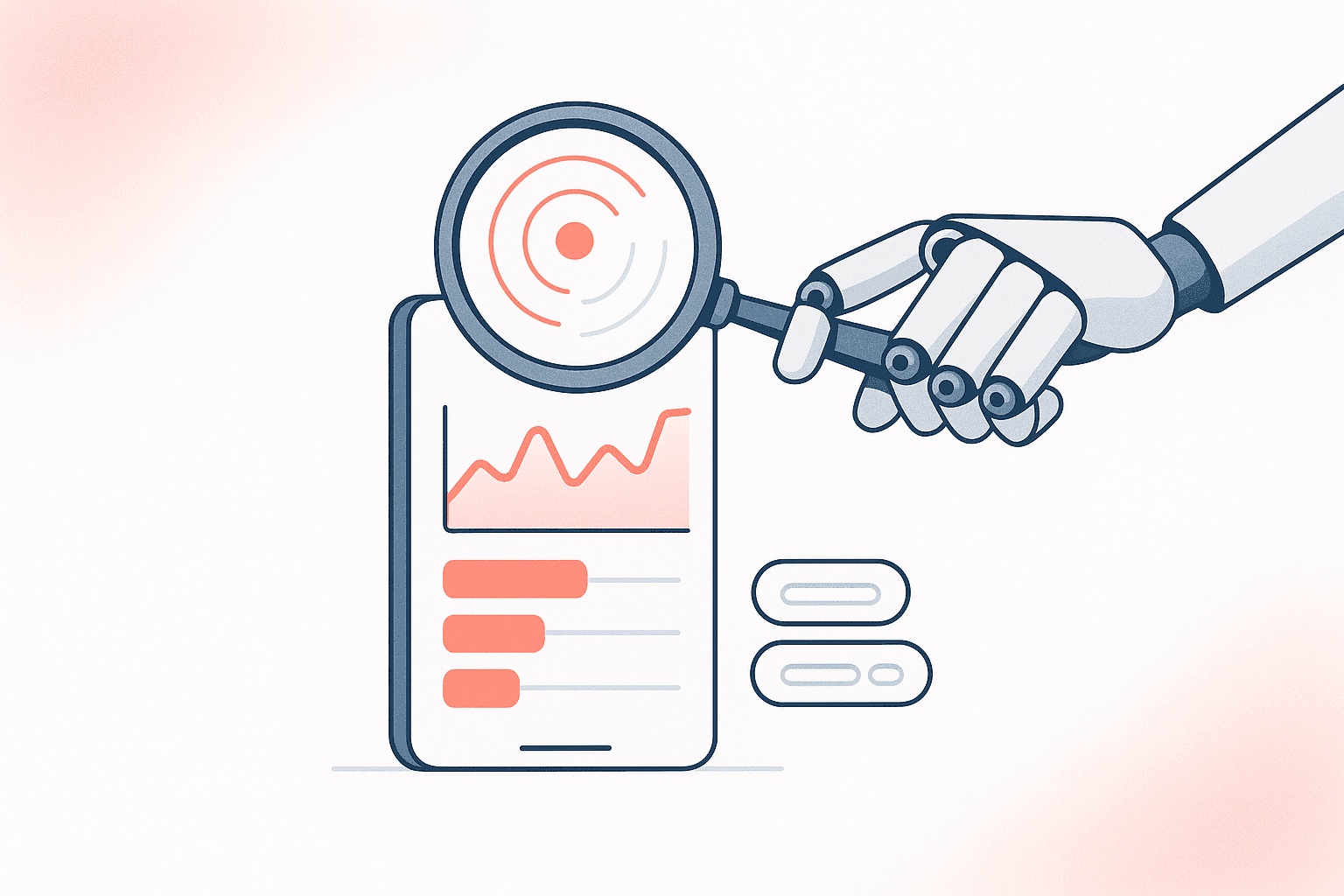
ASO Is a Perfect Problem for AI Agents
Most ASO work is repetitive, data-heavy, and follows clear decision patterns. Research keywords. Check difficulty. Monitor rankings. Spot drops. Update metadata. Repeat weekly, per app, per country, per store.
If you manage one app in one country, this is a 30-minute weekly task. If you manage 10 apps across 5 countries on both stores, it's a full-time job. And that's exactly the kind of work AI agents are built to handle.
An AI agent — an LLM with tool access and a goal — can execute an entire ASO workflow autonomously. Not "generate a keyword suggestion." Actually do the research, evaluate the data, compare against competitors, and produce a prioritized action plan. The difference between AI-assisted and AI-agentic is the difference between a calculator and an accountant.
What Agentic ASO Looks Like in Practice
Here's a concrete example. You tell your agent: "Find keyword opportunities for my meditation app in the US and UK stores."
A traditional tool shows you a search box. You type keywords one by one, scan results, export to a spreadsheet, repeat for the next country.
An AI agent with API access does this:
- Calls
/api/v1/apps/lookupto pull your app's current metadata - Calls
/api/v1/apps/extract-keywordsto identify what keywords you're already targeting - Calls
/api/v1/keywords/suggestionswith your app's category and existing keywords to discover new candidates - For each candidate, calls
/api/v1/keywords/searchto get difficulty and popularity scores — similar to what you'd find on the yoga app keyword difficulty page - Filters to keywords in the sweet spot (SP 35-55, difficulty under 35)
- Cross-references against your current rankings to find gaps
- Returns a prioritized list with specific metadata recommendations
All of that happens in one prompt. No clicking, no spreadsheets, no tab switching. The agent has the same analytical framework a human ASO expert would use — it just executes it in seconds instead of hours.
Why Dashboards Don't Work for Agents
Most ASO tools were built for humans sitting at a browser. They have dashboards, charts, dropdown menus, and paginated tables. None of that works for an AI agent.
An agent needs three things from a tool:
- A clean API — structured JSON endpoints it can call programmatically
- Stateless operations — no session cookies, no multi-step wizard flows, no "click here to continue"
- Predictable responses — consistent schemas the agent can parse and reason about
This is why we built our API access as an agent-first product: prepaid credits, JSON in and out, no subscription, no dashboard required. Nine stateless endpoints cover the full research workflow. An agent using Claude, GPT, or any other LLM can call these endpoints directly via tool use (function calling) and build complete ASO workflows without ever rendering a webpage.
The CLI follows the same philosophy — see our API and CLI workflows guide for practical examples. sonar keywords search "meditation timer" --country us --json returns structured data that pipes cleanly into any automation.
The MCP Connection
If you're using Claude with Model Context Protocol (MCP), our API endpoints map directly to MCP tools. An MCP server wrapping our API gives Claude native access to keyword research, difficulty analysis, app lookup, and review monitoring — all as first-class tools it can call mid-conversation.
This means you can have conversations like:
> "Check if any of my tracked keywords dropped more than 5 positions this week, and for the ones that did, suggest replacement keywords with similar intent but lower difficulty."
Claude calls the API, processes the data, and responds with actionable recommendations. No context switching, no manual data export, no copy-pasting between tools.
The practical difference between a raw API and an MCP integration is context persistence. When Claude calls an ASO endpoint through MCP, it retains the results in its conversation context. It can reference keyword data from three messages ago, compare it against new results, and build on earlier analysis without you re-stating the problem. A raw API call is fire-and-forget — MCP turns it into a continuous research session where each step informs the next.
Setting up an MCP server for ASO takes about 20 lines of configuration. You define each API endpoint as a tool with its parameters and description, point it at your API key, and Claude can call it natively. No wrapper code, no middleware, no authentication dance per request. The MCP server handles auth once, and every subsequent tool call in the conversation is authenticated automatically.
Automating Keyword Gap Analysis
Keyword gap analysis — finding keywords your competitors rank for but you don't — is one of the highest-value ASO activities. It's also one of the most tedious to do manually. You need to pull keyword lists for multiple apps, normalize the data, compute the differences, then evaluate each gap keyword for viability.
An agent turns this into a single request. Here's what the workflow looks like:
# Pull competitor keywords and compare against your app
sonar competitors keywords --app-id 123456789 --competitor-id 987654321 \
  --country us --json | \
  claude "Identify the 10 best keyword gaps — keywords they rank for in the
  top 20 that I don't rank for at all. Filter to difficulty under 40 and
  popularity above 35. For each, explain why it's a good opportunity and
  suggest where to place it in my metadata."
The agent doesn't just return a list. It evaluates each gap keyword against your app's category relevance, current metadata density, and the competitive landscape for that term. A human doing this manually would spend 30-60 minutes per competitor pair. An agent does it in seconds — and you can run it across your entire competitor set in a single session.
For portfolio developers, this compounds dramatically. Run gap analysis across 5 apps and 3 competitors each, and you have 15 competitor pairs analyzed in under a minute. The agent can then cross-reference the results to find keywords that represent opportunities across multiple apps in your portfolio, or identify which specific app is best positioned to capture each gap keyword.
Real Agent Workflows
Here are workflows that agents are already running against our API:
Weekly Rank Monitoring
An agent runs on a cron schedule, pulls rank data for all tracked keyword-app pairs, compares against the previous week, and posts a summary to Slack. If any keyword drops more than 3 positions, it automatically researches alternatives and drafts metadata change suggestions.
Competitor Intelligence
An agent monitors competitor apps' metadata changes (title, subtitle, description updates). When a competitor adds a new keyword to their title, the agent checks its difficulty and popularity, evaluates whether you should compete for it, and adds it to a watchlist if it's viable.
New App Launch Optimization
An agent takes a new app's description and category, runs a full keyword research cycle, and outputs optimized metadata for both iOS and Google Play — title, subtitle, keyword field (iOS), short description, long description — in a single pass. What normally takes an ASO consultant 2-3 hours happens in under a minute.
Portfolio-Wide Keyword Allocation
For developers with multiple apps, an agent can analyze keyword coverage across the entire portfolio. It identifies keyword cannibalization (two of your apps competing for the same term), coverage gaps (keywords nobody in your portfolio targets), and reallocation opportunities (moving a keyword from an app that can't rank for it to one that can).
The Cost Advantage
Traditional ASO tools charge $50-300/month for dashboard access. You're paying for the UI, the servers rendering charts, the session management, the user authentication layer.
Our API runs on prepaid credits — packs start at $10 for 1,000 calls, you get 50 free credits on signup, and there's no subscription at all. You get the same underlying data — keyword difficulty, search popularity, app metadata, review analysis — without the dashboard overhead. For an AI agent, the dashboard is dead weight. The data is what matters.
For indie developers running AI coding assistants like Claude Code, Cursor, or Windsurf, this means your development agent can also be your ASO agent. Same tool, same workflow, same conversation context. Ask it to build a feature, then ask it to research keywords for that feature — without switching tools.
What's Coming
The agentic ASO space is moving fast. Here's where it's going:
Automated metadata A/B testing. Agents that change your app's keywords, monitor rank changes for 2 weeks, and roll back if performance drops. Continuous optimization without human intervention.
Cross-store strategy. An agent that understands the different ranking algorithms of iOS and Android, and optimizes metadata separately for each store while maintaining consistent branding.
Review sentiment analysis. Agents that read competitor reviews, extract feature requests and complaints, identify unmet user needs, and suggest keywords that match those needs.
Predictive difficulty. Instead of measuring current difficulty, agents that predict how difficulty will change based on market trends, new app launches, and seasonal patterns.
Building Your First ASO Agent
If you want to start with agentic ASO today, here's the minimal setup:
- Get an API key — sign up (50 free credits included), create an API key, and top up with prepaid credit packs from $10 when you need more
- Connect to your LLM — add our API endpoints as tools/functions in your agent framework
- Define a workflow — start simple: "Research the top 20 keyword opportunities for [app name] in [country]"
- Iterate — add more steps as you see what works: competitor analysis, rank tracking, metadata generation
The API is designed to be agent-friendly from the ground up. Every endpoint returns structured JSON, every parameter has clear semantics, and every response includes enough context for an LLM to reason about next steps.
# Example: keyword research via CLI, piped to an agent
sonar keywords search "habit tracker" --country us --json | \
  claude "Analyze these keywords and recommend the top 5 for a new habit tracking app"
Key Takeaways
- ASO workflows are repetitive, data-heavy, and follow clear patterns — ideal for AI agents
- Agents need APIs, not dashboards — most ASO tools were built for humans and don't work for agents
- Our prepaid API credits (packs from $10, 50 free on signup) cover 9 stateless endpoints with no subscription, built for LLM tool use
- MCP integration lets Claude call ASO endpoints as native tools mid-conversation
- Real agent workflows include weekly rank monitoring, competitor intelligence, launch optimization, and portfolio-wide keyword allocation
- The future of ASO is continuous, autonomous optimization — not monthly manual keyword reviews